Resources, tools, and tips designed for you
No matter where you are in your journey, there are many resources available to help.
For questions about financial assistance, call 1-866-MY-APL-ASSIST



Laura is an adult with PNH who’s taken EMPAVELI
No matter where you are in your journey, there are many resources available to help.
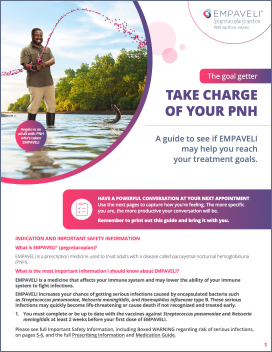
Doctor Discussion Guide
This guide provides questions and prompts to help you start a productive conversation with your doctor about treatment options. Take the first step to discover if EMPAVELI is the right option for you.
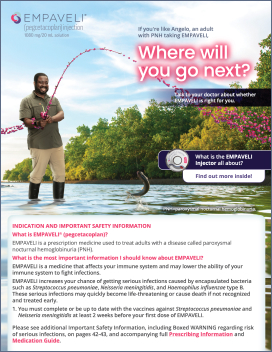
EMPAVELI Treatment Brochure
A complete guide to understanding EMPAVELI including information on benefits, how it works, and side effects.
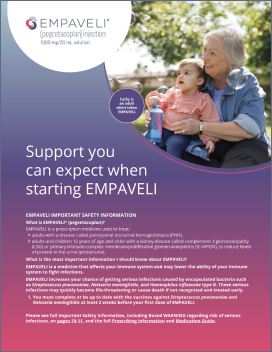
Support for Getting Started Guide
A guide that takes you from prescription to your first time self-administering EMPAVELI. This guide includes information about the support you can expect as you begin treatment with EMPAVELI, and who to contact if you have questions.
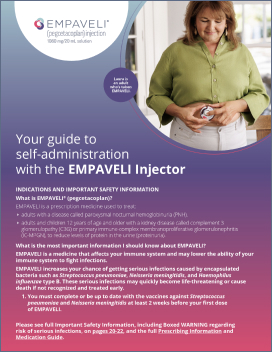
Self-administration Guide
A guide to self-administering EMPAVELI with step-by-step instructions.
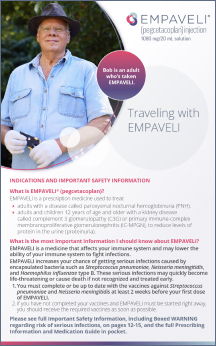
Travel Guide
A brochure with helpful information for travel and preparation so that taking trips can be easier.
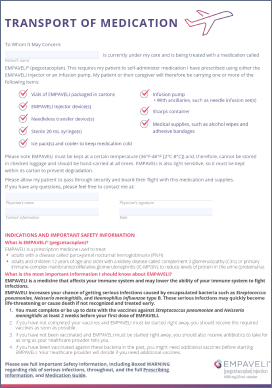
Travel Letter
The EMPAVELI Travel Letter explains the supplies you need to travel with in order to self-administer EMPAVELI. Presenting this letter to customs and security officials, along with your prescription, will help ensure you move through security easily.
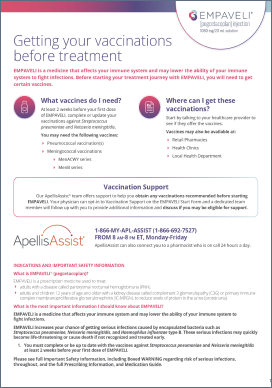
EMPAVELI Vaccine Brochure
An overview of the support available for the necessary vaccinations before starting treatment with EMPAVELI.
HSH provides tools and tips to help you stay organized, store your medication, and get comfortable in your own space.

My Infusion Studio
A case to store all of your non-refrigerated treatment supplies.

Refrigerator Storage
A secure storage solution for your medication cartons.

Travel Bag
A cooler to keep your medication at the right temperature for up to 19 hours.

HSH TV
Get expert advice on storage and comfort from interior designer, Genevieve Gorder.

National Organization for Rare Disorders (NORD®)
NORD builds community and creates a lasting impact by improving health and well-being of people with rare diseases by driving advances in care, research, and policy.

Aplastic Anemia & MDS International Foundation (AAMDSIF)
Since 1983, AAMDSIF has been a constant source of support for people living with PNH, aplastic anemia, and myelodysplastic syndrome. They offer a wide range of educational tools, resources, community events, and programs, as well as a Peer Support Network to help connect you with other community members who may have similar experiences. They also have a robust list of resources.
The resources on this website are meant to be informational only and are not intended to replace medical advice. Always talk to your healthcare provider about any medical decisions, including how to manage your PNH and how it affects your everyday life.
Apellis Pharmaceuticals, Inc. is not affiliated with nor endorses any particular organization, and is not responsible for the content of any sites or resources we may link to from this website, and makes no guarantees about the accuracy of the information or the quality of support provided.
“We have many valuable tools and resources to help folks be successful on their treatment journey.”
Chrissi,
a real ACE
OLE=open-label extension; PNH=paroxysmal nocturnal hemoglobinuria.
EMPAVELI is a medicine that affects your immune system and may lower the ability of your immune system to fight infections.
EMPAVELI increases your chance of getting serious infections caused by encapsulated bacteria such as Streptococcus pneumoniae, Neisseria meningitidis, and Haemophilus influenzae type B. These serious infections may quickly become life-threatening or cause death if not recognized and treated early.
Your healthcare provider will give you a Patient Safety Card about the risk of serious infections. Carry it with you at all times during treatment and for 2 months after your last EMPAVELI dose. Your risk of serious infections may continue for several weeks after your last dose of EMPAVELI. It is important to show this card to any healthcare provider who treats you. This will help them diagnose and treat you quickly.
EMPAVELI is only available through a program called the EMPAVELI Risk Evaluation and Mitigation Strategy (REMS). Before you can take EMPAVELI, your healthcare provider must enroll in the EMPAVELI REMS program, counsel you about the risk of serious infections caused by certain bacteria, give you information about the symptoms of serious infections, make sure that you are vaccinated against serious infections caused by encapsulated bacteria and that you receive antibiotics if you need to start EMPAVELI right away and you are not up to date on your vaccines, and give you a Patient Safety Card about your risk of serious infections.
Do not take EMPAVELI if you:
Before you take EMPAVELI, tell your healthcare provider about all of your medical conditions, including if you:
Tell your healthcare provider about all the vaccines you receive and medicines you take, including prescription and over-the-counter medicines, vitamins, and herbal supplements which could affect your treatment.
If you stop taking EMPAVELI, your healthcare provider will need to monitor you closely for at least 8 weeks after stopping EMPAVELI. Stopping treatment with EMPAVELI may cause a breakdown of red blood cells due to PNH.
Symptoms or problems that can happen due to red blood cell breakdown include:
EMPAVELI can cause serious side effects including allergic reactions. Allergic reactions can happen during your EMPAVELI infusion. Stop your EMPAVELI infusion and tell your healthcare provider or get emergency medical care right away if you get any of these symptoms during your EMPAVELI infusion:
The most common side effects in people with PNH treated with EMPAVELI include injection-site reactions; infections; diarrhea; pain in the stomach (abdomen); respiratory tract infection; pain in the arms, hands, legs, or feet; low potassium in blood; tiredness; viral infection; cough; joint pain; dizziness; headache; and rash.
These are not all of the possible side effects of EMPAVELI. Tell your healthcare provider about any side effect that bothers you or that does not go away.
Call your healthcare provider for medical advice about side effects. You may report side effects to FDA at 1-800-FDA-1088 or www.fda.gov/medwatch.
EMPAVELI is a prescription medicine used to treat adults with a disease called paroxysmal nocturnal hemoglobinuria (PNH).
Please see full Prescribing Information, including Boxed WARNING regarding risk of serious infections, and Medication Guide for additional information.
By submitting this form, I acknowledge that I have reviewed, understood, and agree to the below guidelines, that I am at least 18 years of age and am legally competent to enter into this agreement, that I own all rights to the content submitted, and that I have received permission to submit the content from any other individual appearing in my submission for use by Apellis Pharmaceuticals, Inc. (“Apellis”), as set forth below.
Apellis can take, collect and use any content I have submitted to this webpage, including my photographs, film or recordings taken of my image and voice, my quotation or testimonial, as well as any personal health information contained in such photographs, film or recordings or provided on this submission form (collectively, “My Content and Information”). Apellis reserves the right to not post or use My Content and Information.
Apellis and its subsidiaries, affiliates, licensees, successors, assignees and those acting with its authority, have the right to use, re-use, broadcast, display and publish My Content and Information on social media, websites, displays, and emails. I waive all rights that I may have to claims for payment or royalties in connection with the posting or other usage of My Content and Information on these platforms. Apellis will contact me by e-mail or phone if it would like to feature My Content and Information elsewhere.
Any content that I submit to Apellis may be edited or excerpted in Apellis’ sole discretion to align with promotional requirements and the intended use of this site. I waive all rights in My Content and Information, including any right to inspect or approve My Content and Information prior to use or dissemination by Apellis. If significant changes are required, Apellis may contact me via e-mail or phone. Apellis will not use my e-mail address or phone number for any other purpose, unless I have separately opted into receiving communications from Apellis.
Adverse Events (“AEs”): Apellis will address any adverse events or side effects mentioned within submissions according to FDA regulations. You may report side effects to FDA at 1-800-FDA-1088 or www.fda.gov/medwatch.
Sign up to join the EMPAVELI PNH community:
EMPAVELI is a medicine that affects your immune system and may lower the ability of your immune system to fight infections.
EMPAVELI increases your chance of getting serious infections caused by encapsulated bacteria such as Streptococcus pneumoniae, Neisseria meningitidis, and Haemophilus influenzae type B. These serious infections may quickly become life-threatening or cause death if not recognized and treated early.
Your healthcare provider will give you a Patient Safety Card about the risk of serious infections. Carry it with you at all times during treatment and for 2 months after your last EMPAVELI dose. Your risk of serious infections may continue for several weeks after your last dose of EMPAVELI. It is important to show this card to any healthcare provider who treats you. This will help them diagnose and treat you quickly.
EMPAVELI is only available through a program called the EMPAVELI Risk Evaluation and Mitigation Strategy (REMS). Before you can take EMPAVELI, your healthcare provider must enroll in the EMPAVELI REMS program, counsel you about the risk of serious infections caused by certain bacteria, give you information about the symptoms of serious infections, make sure that you are vaccinated against serious infections caused by encapsulated bacteria and that you receive antibiotics if you need to start EMPAVELI right away and you are not up to date on your vaccines, and give you a Patient Safety Card about your risk of serious infections.
Do not take EMPAVELI if you:
Before you take EMPAVELI, tell your healthcare provider about all of your medical conditions, including if you:
Tell your healthcare provider about all the vaccines you receive and medicines you take, including prescription and over-the-counter medicines, vitamins, and herbal supplements which could affect your treatment.
If you stop taking EMPAVELI, your healthcare provider will need to monitor you closely for at least 8 weeks after stopping EMPAVELI. Stopping treatment with EMPAVELI may cause a breakdown of red blood cells due to PNH.
Symptoms or problems that can happen due to red blood cell breakdown include:
EMPAVELI can cause serious side effects including allergic reactions. Allergic reactions can happen during your EMPAVELI infusion. Stop your EMPAVELI infusion and tell your healthcare provider or get emergency medical care right away if you get any of these symptoms during your EMPAVELI infusion:
The most common side effects in people with PNH treated with EMPAVELI include injection-site reactions; infections; diarrhea; pain in the stomach (abdomen); respiratory tract infection; pain in the arms, hands, legs, or feet; low potassium in blood; tiredness; viral infection; cough; joint pain; dizziness; headache; and rash.
These are not all of the possible side effects of EMPAVELI. Tell your healthcare provider about any side effect that bothers you or that does not go away.
Call your healthcare provider for medical advice about side effects. You may report side effects to FDA at 1-800-FDA-1088 or www.fda.gov/medwatch.
EMPAVELI is a prescription medicine used to treat adults with a disease called paroxysmal nocturnal hemoglobinuria (PNH).
Please see full Prescribing Information, including Boxed WARNING regarding risk of serious infections, and Medication Guide for additional information.